skip to main |
skip to sidebar
 The Syrian Christians are an old community in the state of Kerala, on the southwest coast of India. Christianity came to Kerala from the middle east; in the old days, the Kerala Orthodox church fell under the control of the Patriarch of Antioch in Syria -- hence the name.
Kerala cooking has received its share of kudos recently, but most people would be surprised by the consistency of its values -- perfectly cooked, tender fish and meat, vegetables with bite, short grained, unpolished red rice, and a variety of breads. Many Indians are careless about texture and bite -- does that ring true about your favourite local Indian restaurant? -- but not in Kerala. The spicing is in some ways characteristically Indian Ocean. Usually, one starts curries by thoroughly cooking the spice base, which is turmeric and red chilli that you find in most of India, plus coriander seed in place of the cumin that they use in North India. Usually the ratio is turmeric:coriander:red chilli as 1:2:4. After the spice base, comes the fresh base: ginger and garlic made into a paste. On this foundation of spices and fresh aromatics comes whatever makes a dish different: the fish or meat and the special flavours -- very often coconut milk is used as the liquid and thickener.
The fish curry shown above is the emblematic meen vevichathu, commonly known as Kerala Red Fish Curry. I took the photograph from a good recipe at http://sairaboby.wordpress.com/2007/06/26/meen-vevichathukerala-fish-curry/. (Saira's sauce is slightly lighter in colour and thinner than you would find in my family.) The characteristic ingredient in this dish is kudam puli -- the large black pieces in the photo -- a fruit which imparts a somewhat taramindy taste to the curry, giving it an attractive complexity of flavour -- it's a hot curry, with a characteristic back-of-the-mouth sharpness. (I don't know where one would get kudam puli in North America.)
The fish is generally dense, not flaky -- a big fish like sea-bass or halibut -- the local equivalents, of course -- not a flat fish. Syrian Christians are good at cooking fish just right -- it's cooked (not raw, as in Japan), but still tender and moist. (Grilled flatfish is divine in Kerala -- I am sorry to my Croatian friends for saying so, but Dubrovnik doesn't have anything to match it.)
This is a Syrian Christian banquet:
 You get a glimpse of the red rice on the right edge of the table, three dishes from the bottom. The meen vevichathu is at the back: here is a closer look -- in the long dish:

It's served with a dense fibrous starch, often kuppa or tapioca, but here breadfruit (just above the fish).
Below we have a bread known as appam -- the rice flour is raised with fermented coconut milk and yeast, and eaten with a light coconut milk chicken curry:
 Kerala cuisine is complex and varied. Syrian Christians have the best of it, I think -- though the dishes are closely related to those other Malayalis make, there is a refinement in their flavours which surpasses the rest. It is probably not the easiest cuisine to get into -- the flavours are unfamiliar, and the routines and rituals of combination and order and what to eat when are complex. (For instance, you never eat yoghurt until right at the end -- you use it to sop up the left over gravies on your plate.) As a child, I preferred other things. Now, I think it's one of the best country cuisines -- i.e., it's not to be compared with the showy metropolitan cuisines you find in Delhi or Instanbul or Paris -- the world has to offer.
A recent New Yorker article remarked on the fragility of health and well-being after sixty. You're not surprised that one of the US presidential candidates is seventy, but you are also not surprised to come across somebody, who at sixty finds it difficult to walk a trail that's a bit uphill and downhill. True, we are not surprised by different kinds of outcome after a longish life, but as we have recently begun to find out, the generation that was born in the years following WWI (1918-1930) is proving remarkably durable.
My grandfather had a tough independence movement: he was a political leader among Kerala Christians, and when the administration of the state decided to fix things so Kerala would be dominated by Hindus, he found his business under attack. He spent time in jail, which shattered his health. Though thoroughly rehabilitated after Independence -- a member of Parliament and India's ambassador to the Sudan -- he suffered from diabetes and insomnia and died in his early seventies. No doubt he very much missed his wife, my grandmother, who died in her early fifties -- she had a weak heart, and it was overstrained by taking care of a large brood in difficult circumstances when her husband was in jail.
Their children, who, like their mother, shared in my grandfather's distress, are nevertheless very well. Six survive, the oldest (my father) and the youngest having succumbed to cancer. They range between 78 and 87 -- very much changed, of course, from when, as a child, I first formed my impressions of their characters and intelligence, and when they were young, glamorous, and in charge.
On a recent trip to India, I found it surprising how well these people, and others, seemed, into their eighties and nineties. I visited ten or so people of this generation, many of whom I hadn't seen in many years. I was struck by how much the same they were mentally as before, and how little affected by age in quickness of mind, mobility of body, and vitality of spirit.


When I was much younger, we thought it very fortunate when somebody lived to be eighty. Now, we are all familiar with individuals who at eighty and much older, continue to function at much the same level as they did twenty or forty years ago, and even to thrive in conversation and debate.
The post-WWI generation is going to surprise us. Once, we hardly knew anybody older than eighty: soon we are going to know many who function pretty well at a hundred. (I just hope Robert Mugabe isn't one of them.)
Recently, I flew three long legs (Frankfurt-Bangalore, Bangalore-Frankfurt, Dusseldorf-Toronto) on Lufthansa First Class (on points, I might say). The first leg of the trip, from Toronto to Frankfurt was on Business. There is a difference.
Back in the seventies and early eighties, flying economy was quite pleasant, even for long distances. You'd be served a drink (on Canadian airlines, usually a double) -- during the recession of the early eighties, you'd usually have a seat open next to you, and drinks were free. Then, you'd get a hot meal, with a choice between two main courses. Wine of a mediocre standard would be served. And then they'd come around with brandy.
(That was in the seventies and eighties. Back in the thirties, there was only one class, and here is how it looked (on three different airlines):
 The New York Times, from which I got this illustration, points out, however, that flights were much bumpier in those days -- with smaller aircraft and lower altitudes. Indeed, I remember flying prop planes in the fifties -- when you boarded, you hit an olfactory wall of eau de cologne, sprayed to cover the smell of airsickness upchuck.)
When bigger aircraft were introduced (747s), their length demanded an extra galley and toilet station in the middle, and so the plane was divided into separate cabins. Soon airlines started reserving a small cabin in front for people who wanted a little quiet -- no children, no movie, that kind of thing. That was the start of Business Class. Gradually, it became quite a bit fancier, as economy class slid into greater and greater squalor. To compensate for the steep price of full fare economy, airlines introduced some perks, primarily fancy seating and good leg room, and somewhat better food.
Today, business class inside North America, or Europe or Asia is very little different from the economy class of the early eighties. It is attractive only because utter misery prevails behind. Lufthansa's business class from Toronto to Frankfurt was a lot better than even ancestral economy, but it too bore the stamp of its origins. Meals came from a cart; you could get a drink only when the cart passed by; the main course is loaded pre-assembled and heated up on board.

First Class is a different matter altogether, starting with the airport lounge, which is sumptuous, has luxurious meals, bathrooms with a tub you can soak in -- the works. Above, you see a tray in one of Lufthansa's Frankfurt lounges: malt whiskies from Germany, Japan, New Zealand, and Austria. Now who would have thought of that?
First Class too has its origins in the old days, where it was an experience quite distinct from the pleasant but plain fare in the back. Here, there is service. You are addressed by your name, usually by charming, more senior stewardesses, who know how to entertain in the grand style. Meals are assembled in front of you, or in the on-board galley, and brought to you individually; you taste the wine before it is poured; you are not tied to your seat -- there is a bar from which you can serve yourself and chat with the other members of the elite. And there is luxury. Today, brand names are a kind of currency of hospitality, a way somebody knows how much an arms dealer or lobbyist paid to entertain them. This is how it is in First. The champagne is vintage; the wine is from a well-known chateau; the Scotch is 18 years old; caviar is always one of the entrees.
 And there was something I thought quite unusual on a plane: soup!
 And that most German of delicacies -- fresh white asparagus, which happened to be in season:

By the way, Air Canada has something called Executive First on intercontinental flights; it is a mixture of both. It has the service of First, but not the luxury. The flight attendants address you by name; they are charming senior staff; and included in the crew is a cook who assembles each main course plate on board; there is a stand-up bar. On the other hand, the champagne is Drappier; the Scotch is 12 years old; neither caviar nor fresh white German asparagus is available. But you get a good appetizer, and a main course "cooked" for you on board, and served individually.
A while ago, Joanne Kates wrote a column in which she strongly preferred Lufthansa's Business class food to Air Canada's. I find this hard to believe. (Was she actually flying Lufthansa First?) How can a meal assembled off plane and heated up in a closed container be better than something assembled on-board? Moisture and pressure are the enemies of airline food, and that's why this procedure has mediocre results -- in Economy you have no choice, of course. The Business Class service on Lufthansa's Toronto-Frankfurt leg was almost comic. Everything was served from a cart. When I asked for another glass of red wine, I was told to wait for the next cart -- which happened to be when dessert came through. They had the cheese and nuts on the meal tray, but whisked it away when the main course came -- Did the others eat cheese before meat? The first was nice enough: a warm duck salad, but the main course came with the foil cover on: it was a over-soyed Chinese-"inspired" meat dish with plain white rice and mixed vegetables, which had been steamed under the cover.
San Diego is very green, and you forget how close it is to the desert:
 But this guy is a reminder:
 Up until recently, I am told, the city was not noted for its food. I went one evening to a Mexican restaurant named Candelas, and found out why. The food here was good, the wine-by-the-glass excellent, and the service elegant. But I was depressed by a party of six, who ordered enormous plates of food and scarfed it all down before my soup came. I don't know if they were military or athletes or what, but the mere sight made me feel slightly queasy. And they're the customers. No wonder the plates are full of food to the point that you face the main courses with apprehension in your heart.
I ordered two primi: a black bean soup made with beer, which was terrific -- lots of complex flavours -- the black beans, pretty much as expected, and then a nice dark beery finish. Then, an avocado and shrimp concoction that tasted more of lime than of the seafood or fruit.
The next night, Jonathan and I tried The Linkery, a restaurant that advertises single-source everything, and having been to Chez Panisse and Cowbell recently, I thought it would be interesting. Jonathan even had a coupon for a free main course.
The Linkery turned out to be an industrial looking restaurant, which had just moved into new quarters:
 Single sourcing is at new heights here. They even tell you how the paper is made and where it comes from:
 We ordered a charcuterie plate to share, and then lamb. The charcuterie itself was very good -- from top to bottom, landjager, bresaola, copa -- but it was the accompaniments that made this plate:
 Each carrot, date, walnut was full of flavour and it was all that I could do to leave Jonathan his fair share. And a wonderfully inky, deep tasting Nebbiolo from Mexico. The main was breast of lamb with merguez, the former tasting milky and the latter perfectly spiced with pepper (but no turmeric that I detected). A great Bordeaux-style blend called Chukker accompanied. (It's wonderful being in California, where one regularly drinks wine of quality that one would go broke for in Canada.) Like Chez Panisse, the vegetables were terrific; unlike CP and Cowbell, the meat was good enough, but not memorable.
With dessert, another first: a dessert beer. An edifying end to a most enjoyable evening.
This is a statue of King Edward VII: an egregiously stupid and gluttonous man with a flexible sense of private morality. Son of Victoria, he became heir to the throne because his brother, who was severely retarded, died before their mother did. 
This fine statue once stood in Delhi, as this plaque below it recounts:
 Now it stands in Queen's Park in Toronto, a sadly shabby space in the centre of this appearance-oblivious city. Paul Fonseca remarks in the Globe and Mail about the "rundown fountain surrounded by unplanted gardens," "the dilapidated benches" and "the neglected monument to a dead monarch
.
" As for the last: how did it get there?
Delhi had many such statues, some of which had their ornamental qualities. The one shown below was at one end of Rajpat, or Kingsway, which has the fabulous Rashtrapati Bhawan, or President's Residence, at its other end.
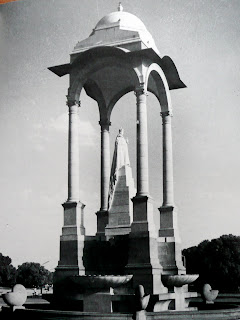 This one has now been removed, and the pedestal stands empty. It is of George V, a somewhat thinner, but equally uncultured son of the man on a horse. The statue of Edward VII was also removed. These and many other statues were stored in kind of graveyard for imperial relics, on the grounds of the old Coronation Durbar, in Civil Lines near Delhi University.
Sometime in the sixties, Henry Jackman had the good idea that Toronto was in need of an equestrian statue. It had many good statues in front of the legislature building in Queen's Park, but all the men so honoured stood on their feet. Jackman contacted his friend, Roland Michener, then Canada's High Commissioner to India, to see if the Government of India would give Toronto its exiled Edward VII-on-horseback. GOI was only too willing to oblige.
The statue was cut into three pieces, shipped to Toronto, rewelded here, and erected in 1969. It looks good where it stands (though grass, as you can see, is a struggle in Toronto).
 Canada and Toronto were unappreciative recipients. In her memoir of her father's time in India, Michener's daughter complains about how long it took to process the papers needed to export the statue. Nowhere in this memoir is there a word of gratitude for the gift. Nor is Toronto properly appreciative for who gave it its equestrian statue. Look closely at the plaque above: you'll see it says that the gift was "made possible" by the Government of India, along with "the former High Commissioner to India, His Excellency Roland Michener C.C, C.D., Governor General of Canada." Michener did indeed make the gift possible, and Jackman paid to transport and install it, but surely the Government or the people of India should be acknowledged as the donors (rather than as facilitators).
Jackman was right about equestrian statues: no city is complete without one. Soon others began to hear the call. A couple of blocks away, in St. Michael's College, there now stands this charming example of the genre:

Not quite as imposing as Edward Emperor of India perhaps, but at least this one doesn't look like the type who cadges money and mistresses from his friends.

 Grace is a new restaurant at 503 College Street – where Xacutti used to be. It’s billed as “modern farmhouse”, and we discussed what that might mean – the look is light wood, if that helps, but the cuisine is hip urban. A party of us had plenty of food and lots of fun – the restaurant has only been open a week and seems to have caught the attention of young professional types. There were lots of stylish people to look at, and there was an excellent atmosphere of eating, drinking, flirting, and ogling.
The food is a somewhat mixed experience. Take the halibut poached in olive oil:
 The technique is very effective, since the fish is treated delicately at a relatively low temperature and comes out tender and moist. But the leaves on top did nothing for the dish: it's hard to get them on to the same forkful as the fish, and so they came into my mouth separately. The point of constructed dishes of this sort is that each mouthful should offer you a mixture of textures and flavours -- appearance should be secondary; this isn't El Bulli after all. That didn't happen. I regret to say that the pink stuff underneath was grapefruit. Now, whose idea was that?
There are other glitches: corn soup with crab fritters sounds like a fantastic appetizer -- but the fritters were doughy and didn't have any crunch; there was a pleasantly presented potato salad -- but the potatoes were overcooked and mealy. However, the scallops you see on the right below were perfect: a little crust on perfectly tender and sweet meat.

This is a fun place, and our party of five had a very good time, starting from the wine, the friendly service from good-looking waitstaff (though the kitchen was somewhat overwhelmed by the sudden influx of many hearty eaters at about 8 pm), and the atmosphere -- I am sure they will get their act together.
The Michael Lee-Chin Crystal is an impressively futuristic addition to the venerable and beloved Royal Ontario Museum on Bloor Street and Avenue Road in Toronto. Here it is, as it looks from Bloor Street looking east.
 It was designed by Daniel Libeskind, who also did the much more intimidating Jewish Museum in Kreuzberg, Berlin. This is a view of the latter:
 Perhaps you notice some similarities.
The ROM in Toronto is, as you can see, a much more cheerful building -- as it should be, since it has been a weekend destination for many generations of chattering school children. Libeskind's crystal looks as if the old building had been dipped in a supersaturated solution of sugar, and a crystal has grown around it.
 Actually it is a free-standing building, and doesn't even touch the original. Its marvelous aesthetic qualities derive in part from its being such a feat of engineering.
As you walk south along Philosophers' Way, which runs along the west side of the building, you lose sight of the main bulk of the crystal, and this is what you see: A corner of the crystal just overtopping the roof line of the old building. From the south, it looks like this:

From here it doesn't look so much like a crystal, but more like a head-like form with its throat resting on the roof line, with the chin hanging over. It reminds me a lot of this . . .
 . . . the great horse from the Moon's chariot, with its chin overhanging the east pediment of the Parthenon.
Cowbell (1564 Queen St. W, Toronto) is a restaurant devoted to meat -- but it is nothing like a steakhouse. In fact it has a rather esoteric specialty: whole-animal butchering. They get sides of beef, or whole animals, and butcher them on-site. They are not, they insist, a steakhouse -- and they are right. The emphasis is on pieces of meat not usually found in restaurants, and on combinations of cuts. Very little goes to waste, they say: all the meat finds its way to the table.

It is hard to get into Cowbell, since it is all the rage right now. When you arrive, you find yourself in an unpretentious room (in an unpretentious part of town), evidently done to the owners' taste (no Restaurant Makeover stunts), with an ornate but slightly tatty plush covering on the benches, and bare wood on the chairs. They claim it looks like a French bistro -- and Joanne Kates seemed to agree in her September 15th review. Maybe it does look like some examples of that genre, but where's the zinc on the ceiling? And there were no shiny, floury, boozy sauces either -- the meat is embellished by natural broths, reduced but not thickened, and enhanced by the flavour of very fresh vegetables.

The table that's closest on the left was a party of very loud louts who caused us to ask to be moved. You might think that restaurants would either install sound deadening ceilings (though that wouldn't have helped with this crowd) or get people to quiet down when they are over-exuberant (read: drunk).
Anyway, I went there with a friend I hadn't seen since we were undergraduates together.
 He ordered a plate of greens ("Soiled Reputation Greens") and a plate of pork, which had sausage, belly (I think), and a bit of ear. I ordered duck soup and a hot pot, which is Lancashire style. We were too busy catching up, and too distracted by the louts, for me to do any serious tasting or photography. The quick impression is that the duck soup was Chinese-influenced -- a clear and non-fatty broth with a good taste of mushroom and pepper, all fat taken out. The hotpot is a large piece of brisket in another rich broth -- beautifully tender and rich tasting.
This is a great restaurant -- it's Toronto's shot at Chez Panisse, though not quite in the same league -- and it deserves another, more serious visit. It's run by enthusiasts: Michael Cutrara, the chef, dropped by to chat -- wow he's serious. Like Bill Buford, he apprenticed as a butcher half-way through his (still young) career -- worked at the Healthy Butcher.
It cost 120 for two including two glasses of wine each. More later.
The National Art Gallery in Ottawa is a gorgeous building by Moshe Safdie. This photograph was taken from the Peace Tower. I apologize for being didactic, but notice how the cupolas echo those on the lovely old Parliament building:
 Here is the cupola from the inside:

Do you, by the way, notice a similarity with this skylight?

This one, which you might recognize by the surrounding forms, is at the Guggenheim Museum in New York, by Frank Lloyd Wright.
Another thing you might notice is that odd concrete angle in the glass wall on the right side. I'll come back to that in a moment.
Here is the glass wall close up.
 Inside, the angle that you saw earlier (and immediately above) is revealed for one of these lovely transitional ramps which takes you from level to level. This is another one, with a skylight above:
 The detail on the wall above is ceramic pieces like this:

And two of the skylights cap courtyards like this one:
 The only thing in the building that made me seriously grumpy was the stupid painting by Barnet Newman, "Voice of Fire". Three stripes, the outer ones of the same colour. Less interesting therefore than the French tricolour, which at least has three colours. Of course, this is "minimalism": the philosophy that contrary to Aquinas, more is not better. Newman was perhaps the least interesting of the New York expressionists -- he doesn't express anything.
Looking at "Voice" close up, I discovered that the colour from each stripe had bled into the next one. Newman didn't seem capable even of the house-painter's art of painting a clean edge:

A three year old could have done that, right?
In the audioguide, a moronic curator -- you really have to hear him -- explains that if you fixate on a point on the ragged edge, you experience a brightening on one side, and then if you shift your gaze to the other side you get a brightening on that side. A sort of dancing, coruscating effect. This is supposed to account for Newman's title 'Voice of Fire'. The coruscation reminds this curator of fire apparently. Presumably, it is an elementary adaptation effect on retinal cells: you fixate on a point on the boundary and the long-wave cone cells on the red side get adapted. Then when you shift to the blue side, the short-wave cells at the same location get excited, making the blue side look a purer blue. You don't need a painting worth a million and a half to prove this: a little demo in the lab would do. It is certainly interesting if somehow the ragged edge contributed to this -- but I would venture to say it still doesn't make this a work of art.
Barbeque is different everywhere. In the southern US, where they use tomato sauces and plenty of sugar, the meat has to be basted on late in the grilling process -- otherwise, it gets bitter -- and the result is a wet sticky coating that some people affect to like -- perhaps they have never tasted anything else; perhaps, they like sweet, sticky stuff. (See the posts on Cluck, Grunt, and Low, and Miga, below.) In Brazil, it is tender and sweet.
In India, tandoori dishes -- Indian barbeque -- have two essential ingredients. First, they are marinated in spices and yoghurt -- the spices include ginger and garlic, as well as cumin and red pepper, and other things depending on taste, including coriander seed and the like. Second, they are cooked in a tandoor, a pear-shaped clay oven that is typically situated underground. People make a big deal of how specialized such an oven is, but I remember that in my high school, when a bunch of Indian Army officers visited, they constructed a tandoor on the spot, especially for their meal. (Indian Army engineers would do wonders for restaurant cuisine in far-away North America, where there are still cities that haven't experienced a tandoor. Come take Canada: please!)
Nirvana Mississauga is to be found on the east side of Hurontario Street at Brunel Drive, one block south of Britannia, which in turn is just south of the 401. As you park, you hear the heavy traffic coming in to runway 06L at Pearson Airport, every two minutes another big Airbus or Boeing. Inside, the restaurant is attractive enough: I suspect the paintings are pretty bad, they do exude an early 20th century elegance. They never hung in any haveli; they may be laser reproductions; but they are pleasant to look at anyway -- at least for me.

The tandoor is manned by a chef who rolls out the dough for naan, spreads it on a convex plate covered by a wet cloth, and uses this contraption to affix the dough on the inside of the incandescently hot tandoor oven. The result is slightly crispy flatbread, quite different from the spongy stuff you get in most restaurants and in Loblaw's (President's Choice Naan, or whatever they call it.)
Here is the tandoor chef, though I didn't catch him very sharply:

He also has long skewers of meat, which he inserts into the hot oven. This man moved slowly and deliberately. He clearly was a man of method.
Andre and I went to Nirvana for the lunch buffet. As Sergio says, Nirvana's contribution to the buffet-concept is to negate it. What you get is better called a prix fixe: appetizer plus four dishes with naan, plus dessert for 12$. No choices. In our case, the appetizer was tandoori wings. (Andre is not eating in an Indian-approved way. I'll explain another time how that is done.)

Here, tandoori cuisine was at its best. The yoghurt marinade had penetrated deeply into the meat which was tender though slightly friable. A nice crust, tender inside, and a gingery overtone to the chicken. At least A-, perhaps that's a little ungenerous.
The buffet included a pleasant but unmemorable saffron rice, potatoes with okra (aloo bhindi), makhani dal (quite good), and chicken curry. A solid B: maybe that's a little generous, but it is a prix fixe. We washed it down with two Kingfishers (each). The main meal didn't match the tandoori chicken, but it was a fun afternoon.

 In some cuisines, dishes are ways of cooking things. A coq au vin indicates how the chicken is cooked and presented. Coq au vin tastes different wherever you get it, reflecting the chicken you use, the wine, the amount of salt, the kind of bacon, and so on. Even with bread making, a name indicates a process, not a product. Brioche is an eggy bread that feels somewhat crisp in the mouth. Can you predict anything else? No: Brioche is made from different flour/egg/milk proportions.
In other cuisines, dishes are quite rigidly prepared and presented, so you know exactly how they are going to look and taste. Italian cuisine is more in this direction than French: German noodles are not recognized as a version of pasta. Pasta can't cooked too soft. It must be made from hard durum flour; it must be al dente. A ragu bolognese must taste of carrots, celery, and onion; the meat must be cooked in milk.
Still, there is room for variation even within these rigid rules. A pasta carbonara isn't ruined because the combination of cheeses is wrong, or the kind of bacon.
South Indian vegetarian cuisine leans much more to the predictable end of things than does French, or even Italian. A dosa is not merely a crepe made of rice flour: it must taste and look the same wherever you get it; similarly an idli, or sambaar, or rasam. You do not make a coriander chutney out of parsley, or a rasam out of limes. (The great mathematician Ramanujan died of lead poisoning, says David Leavitt in his racy novel The Indian Clerk, because when he was at Trinity College in Cambridge, he cooked rasam in a leaden pot. But his broken heart probably got him first, because he could not get tamarind in England and had to substitute lemon. Ugh!)Saravana Bhavan (apparently misspelled on the sign outside) is a restaurant at Hurontario and Eglinton in Mississauga. It is tucked away next to the Toys R Us. It has an authentically Tamilian feel, with fluorescent lighting -- which, in India, would have taken the form of naked tube lamps. The waiters have beautiful and authentic Tamilian Brahmin manners: reserved though attentive; nicely spoken but not smarmy.

Tamilian cuisine is unique, even in India. The dosa is its best known product: a thin crepe made from rice and urad dal. Not so famous, but equally deserving of attention, is the idli, a steamed cake made of a similar batter. At Saravana Bhavan, these things are served in the right way -- you don't drink or eat from anything that isn't made of metal -- and they taste just right. The dosas are exactly as you would get them in Madras (or Chennai), and the paper dosa is the especially crisp version. Some small criticisms: the filling in the masala dosa is a little too heavy on onions; the tomato chutney is a little too sweet.
Now, let's speak about sambar. According to Wikipedia: "Sambar is essentially a pea and vegetable stew or chowder based on a broth made with tamarind and toomar dal." True, I am sure, but the important point is that it has to taste (almost) exactly like a sambar, and at Saravana Bhavan, it does.
Finally rasam. This is a spicy lentil and tamarind "soup" -- lots of black pepper that hits you at the back of the throat. At Saravana Bhavan, I am tempted to say: it is divine. This is not high cuisine. Not everything that is truly delicious is. And it tastes very much like what I encountered at my mother's table. (Poor Ramanujan!)

This is the office of a women's student association at a Place of Higher Learning somewhere in southern Canada.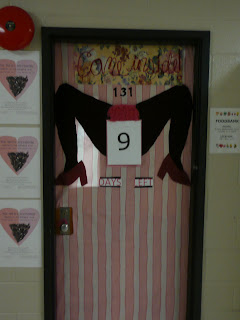 Given the high assumed level of literacy in such a Place, may one assume that everything, including the "Come Inside", is intended?

 You get a glimpse of the red rice on the right edge of the table, three dishes from the bottom. The meen vevichathu is at the back: here is a closer look -- in the long dish: