Tuesday, April 19, 2011

The Election


I’ve been out of the country a lot these last few weeks, and perhaps I am not catching the Weltgeist, but this feels to me like the most boring federal election in history. Is anybody really caught up in it? Politics in the US may be vicious and destructive, but here I find it hard to find anybody who wants to talk about the election. Is it because Canada is so well-governed that the outcome doesn’t really matter? Perhaps no issue really divides us. Could it be that the leaders are deliberately turning away from the issues? Or is it that our largely immigrant population has not yet caught on to Canadian electoral politics?


However that might be, Stephen Harper is running this election on competence. Which is odd, because you wouldn’t think that this is a winning strategy for somebody who leads one of the least competent governments in Canadian history. With a few exceptions, we have a Cabinet of dunces, extremists, and partisans. Lawrence Cannon is Foreign Minister and seems only peripherally to be conscious of the vast drop in Canada’s international prestige under his (and his predecessor, Maxime Bernier’s) watch.


  (Bernier lost files by leaving them at the apartment of his girl-friend, a motor-cycle gang chick, shown above.) Peter MacKay, the Minister of Defence, is mostly known for his dashing love life—he made a pass at Condoleezza Rice on national TV, and was rewarded by being called “the nearest thing to eye-candy on the diplomatic circuit” by the New York Times.


Peter van Loan (International Trade) and John Baird (House Leader) are known for their slashing partisanship, Gary Goodyear (Minister of State for Science and Technology) questions evolution. And so it goes.
            The Government itself is not known for its savvy. In the last couple of years, it got economists all over the world riled by eliminating a meaningful Census; it fumbled away Canada’s position as the leading supplier of medical isotopes; it lowered the Goods and Services Tax and eliminated Canada’s budgetary surplus just before that surplus was badly needed to bail us out of the fiscal crisis; it compounded this mistake by introducing Tax Free Savings Accounts; it has an anti-crime agenda when crime is on the decline; it couldn't get elected to the UN Security Council. Oh, and Harper says that this is not the time to discuss whether Canada will lend its support to reforming male primogeniture in England (as Canada must, if it's to change.) (The Government also seems homophobic, though in such a quiet way that one could be mistaken.) It’s hard to say what positive thing this Government has achieved in five years: governing with a minority, it is mostly concerned with politics. Competence? And yet, the campaign is working.
Conservatives (Blue) lead comfortably
  It all points to 145 seats for the Conservatives, a little short of a majority.

Tuesday, January 11, 2011

Two Elites, Two Anti-Elites


People talk a lot about elites these days. The Tea Party is supposed to be anti-elite, for instance, and it has created quite a stir. But not everybody means the same thing by the term.

Yes-answers to the following questions define one kind of elite:
1.     Do you own more than one home?
2.     Do you own a detached house with garden in town?
3.     Is somebody paid to drive you to work (in a car)?
4.     Do food and housing consume less than a quarter of your income?
5.     Do you have tax shelters or deferred income?

Yes-answers to the following define another kind of elite:
1.     Do you prefer live entertainment to TV?
2.     Do you own an iPhone?
3.     Do like restaurants that serve tiny portions for $30 each?
4.     Do you dislike beer, except when it comes from a local microbrewery?
5.     Do you like wine only when it’s from far away?
6.     Do you prefer $7 bread that is hard to chew?
Let’s call the first the economic elite, and the second the lifestyle elite. It’s pretty clear that the two are not highly correlated. People who live in the ritzy areas in town may have some of the habits of the lifestyle elite, but not necessarily because they like the things in question; the lifestyle elite are certainly not all rich.
Now, it seems that all the fuss in the US is about the lifestyle elite. Here is David Brooks, in Bobos in Paradise:
If you are in an elite based on brainpower, like today’s elite, you need to come up with the subtle signifiers that will display your own spiritual and intellectual identity—your qualifications for being in the elite in the first place. [For a marriage ceremony] You need invitations on handmade paper but with a traditional typeface. Selecting music, you need Patsy Cline songs mixed up with Mendelssohn. You need a 1950s gown, but done up so retro it has invisible quotation marks around it. You need a wedding cake designed to look like a baroque church. You need to exchange meaningful objects with each other, like a snowboard engraved with your favorite Schiller quotation or the childhood rubber ducky that used to cradle during the first dark days of your Supreme Court clerkship. . . self-actualization is what educated existence is all about.
Clearly Brooks is talking about the lifestyle elites, and it is clear he is umm. . . upset with them.   
On the other hand, when Margaret Wente writes (in the Globe and Mail):
There’s another problem with the new über-elite (who are also mostly über-smart – you don’t get to run a zillion-dollar hedge fund if you’re dumb). The richer they get, the more out of touch. They only hang around with one another. They never ride the subway, and don’t know a single ordinary person, or even a semi-ordinary one. They’re also super-arrogant. They think they’ve got all the answers.
she is clearly thinking about the economic elite (though she is not upset by the wealth). The lifestyle elite tends to ride the subway.
Now here is a very strange thing about the current US mood. The kind of class rage that drove politics in Europe and parts of Asia in the middle of the last century is now redirected against the lifestyle elite. Well, there are certainly times when the lifestyle elite can be obnoxious--as when they talk about "fly-over states". But is there any other country in the world where, on the one hand, politicians are afraid to say they want to  raise taxes on incomes over $250,000 per year because to say this would lose them votes among lower middle class voters, and even among the unemployed, while at the same time you find admired public displays of rage like Brooks’s—directed against . . . wedding invitations?
It’s possible that this is just confusion—that some clever people like Brooks and Sarah Palin have found a way to rechannel class resentment so that it reacts against middle class behaviour. I don’t think so though. I think Americans just don’t like certain kinds of behaviour. They are upset by people who drink lattes. (In Canada, some like to play Starbucks off against Tim Hortons -- but I don't know that a lot of votes have swung one way or another based on this.) 
What’s is truly odd and inexplicable is this: how is it possible that something so ephemeral can become the engine of a potent political movement?

Tuesday, December 21, 2010

Jonathan Franzen can't write . . .

. . . English.

Here's a sentence from Freedom:


"At home, after checking on the kids, she put on a sleeveless top and little cotton shorts and came after Walter in bed. This was very unusual of her, but thankfully not so unheard-of as to provoke comment and examination; and Walter needed no persuading to oblige her. It wasn't a big deal, just a little late-evening surprise, and yet in autobiographical retrospect it now looks almost like the high point of their life together."

Nice of her to come after Walter did, even if it was unusual. No need for examination though.

Two paragraphs down:


"A few weeks later, Dorothy collapsed at the dress store in Grand Rapids. Patty, sounding like her own mother, expressed concern to Walter about the hospital care she was getting, and was tragically vindicated when Dorothy went into multiple organ failure and died."

It's too bad that Patty's concern about her poor care is vindicated by the multiple organ failure of her mother in law. Vindication can strike pretty randomly, I guess. And this is the first we hear of Dorothy's failure and death.

Turn to any page in the book and you will find at least one sentence of stunning ugliness and and another of analgesic vapidity. 

Sunday, December 19, 2010

British Bank Teller Becomes Dean, is Reappointed, then Fired

On Saturday, December 18th, the Globe and Mail reported that “A bitter dispute at McMaster University’s business school . . . has led to the resignation of the school’s high-profile dean, former business executive Paul Bates.” 
The Globe was not surprised or shocked by what was to me the most startling part of this story. A man without a university education was appointed Dean. According to Macleans (see below): "Bates reportedly got his start as a bank teller in Britain before moving to Canada in the early 1970s. He went on to head up four major brokerage firms and has sat on the boards of the Toronto Stock Exchange and the Canadian Investment Dealers Association, and has served as a part-time commissioner in the Ontario Securities Commission." Before his appointment as Dean, Bates was CEO of Charles Schwab’s Canadian division and taught at the University of Toronto, where he was an adjunct professor, a designation often accorded people with valuable practical knowledge who are asked to teach university level courses. 
Universities often contemplate appointing leaders from outside academia. They should not, and this story illustrates why. Universities do not operate like companies, nor should they. Their function is to produce and transmit knowledge. The production of knowledge is necessarily a wasteful endeavour – there are a thousand bad ideas for every good one, but you don’t know an idea is bad until somebody has put it forward and others have tested it. Very few companies can tolerate this kind of waste. Moreover, ideas are produced autonomously, not at the command of an executive -- there is an important area of operations, therefore, in which academics have no boss. This drives Deans crazy, especially Deans who are used to being captains of industry.
Business executives are rarely tolerant of administrative cultures other than their own (except sometimes the command structure of the military). They regularly excoriate the fact that there aren’t more business people in politics -- read Gwyn Morgan in the Globe for a good example of this -- ignoring the fact that the public accountability of politicians differentiates their endeavour from that of a bank or brokerage. Most business executives would similarly be appalled by the chaotic, highly individualistic, non-team-oriented, non-results-oriented culture of academia. Whether they are right or wrong is not something I want to debate on this occasion. The fact is that business executives are handicapped as academic leaders.
The handicap was pretty evident in Bates's case. The Globe says that, according to a review of the school commissioned by McMaster’s President, “Faculty members soon became “perplexed” about how decisions were made on important academic matters such as chairing tenure and promotion meetings, developing research policies and developing new graduate programs.” In fact, things were so bad that the the faculty association actually took a poll:  80% of the faculty responded, and 80% of those opposed Bates's reappointment. The university’s Board of Governors ignored them. Bates was reappointed for a second term in 2009.
As it turns out, there are indications that Paul Bates was not a great respecter of people even as a business leader. Macleans magazine reported on May 11th 2010 that Bates was in the middle of an “ugly battle” with Schwab employees in 2002. According to Macleans

“A 2002 Financial Post column headlined “Slick salesmanship masked discontent,” blamed Bates for the revolt at the discount brokerage—a dozen employees sent a letter to Charles Schwab’s head office warning that management of the Canadian arm was “no longer acting in the best interest of ourselves or our clients”—and suggested Bates should have been fired as a result (instead, he oversaw the sale of the brokerage firm to Scotiabank)."

Embarrassingly enough, the Financial Post report was later used as a textbook case-study of bad management. McMaster students would find photographs of their Dean in their text-books, cited as an example of poor personnel management.
At McMaster, Bates wanted to attract students with an interest in the “real world”, to treat these students as “customers”, and to remove academics from committee memberships, where (as somebody with his background might think) all they did was slow things down. These are telltale signs of a disconnect between the Dean and the entity he is administering. As Macleans observed: “while Bates’s pledge to treat students as “customers” sounds appealing on the surface, academics argue there’s an important distinction between training someone to do a job and providing them with an education.” 
Macleans continued:  

“One professor, who has been at McMaster for several decades, said it’s more than just a case of Bates and his private sector get-it-done attitude clashing with a bunch of cloistered academics. ‘It has a lot more to do with his conduct and him as a leader of an academic unit,’ he says. ‘Even after being around here for five years, he still doesn’t understand how an academic institution should be governed.’ The professor claimed that Bates appeared to recognize early on that he didn’t have the broad support of the faculty and quickly resorted to a system of rewarding those who were loyal to him—the report cites allegations that Bates attempted to influence tenure and promotion decisions—and marginalizing those who didn’t.” 

And when five of six area chairs at the business school expressed disagreement with the Dean's plans for a new facility in Burlington Ontario, they were officially reprimanded by the Provost (presumably after a complaint by the Dean). Those of us who have spent their lives in academia know how this kind of behaviour clashes with the democratic ideals of the university. Though these ideals are often breached, the bully tactics of a large firm are hardly ever seen on campus. (Incidentally, the facility in Burlington is largely devoted to an executive MBA program, hardly a part of a university's core mission. It was hardly unpredictable that the faculty would oppose this diversion of focus. Praise for the project came from other sources: the execs who took MBAs there, for instance.)
It may be that the faculty at McMaster’s business school are an academically disreputable bunch, and that Bates is being demonized for their pre-existent incompetence and lack of cooperation. But taken as exculpation, this does not strike me as particularly convincing. It is certainly true that an outsider faces resistance when brought in to reform an organization. But aren’t business executives supposed to be good at navigating organizational difficulties of this type? This excuse shouldn’t ring true even to those who think that the “private sector get-it-done attitude” should displace academic waffling.
Here is a maxim that Boards of Governors, stuffed as they are with non-academics, are reluctant to take seriously, though they really should: anybody who has responsibility for academic programs should be a capable, if not a distinguished, academic.

Saturday, December 18, 2010

The King's Speech

Here's the scoop:
  • Guy appointed by god to do god's job has a speech defect. To make up for his/her lack of due diligence, god sends man to cure guy. Under man's tutelage, guy takes oath to serve god, and gives big speech committing his nation to god's care without making a fool of said god (whose faith he was defending, so win-win for god and guy).
That's about it. Colin Firth acted brilliantly as guy, Geoffrey Rush irritatingly as man, and Helena Bonham Carter cloyingly as guy's squeeze: lot's of slap and tickle there.

Thanks to Firth, the movie is extremely entertaining. 

I have been thinking how this movie is a beautiful little exercise in propaganda. First, Guy's daughter, Lilibet, now 83, is remembered less for carrying on in guy's virtuous path, than for having really silly offspring. In the movie, her adorable mom and noble father burnish her pedigree. Attention shifts from silly son (also apparently appointed by god to defend his faith). 

And not bad to revivify the story about guy's wicked elder brother (WEB). WEB is a bully, plus apparently he lost his mind when a not tremendously attractive chick lured him with tricks she learned in a brothel in Shanghai. (Guy himself, as well as WEB, learned them from a Parisienne prostitute named Flora, provided by "equerries" at Buck Pal. -- Shanghai/Paris which would drive a lustful young Englishman mad sooner? Those who say Paris: go see the movie.) 

Secondly, we are reminded that this small island in Europe (that's England, not Corsica) that saved us from Hitler -- led by guy who gave aforementioned speech. Good eh?

England is in tough spot these days, and needs every little boost that its debt-ridden populace can get. Publicly funded films about the glory of the realm don't hurt. When the yobs get excited about Harry and Kate, not to mention the Olympics, the wounded economy may get a little tickle/stimulus. Good investment, guys.

Thursday, November 25, 2010

Is There Supposed to be Something Wrong with Germany?

In this morning's (25/11/10) Globe and Mail, Timothy Garton Ash has an argument that goes something like this: 
  1. Germany is very successful. 
  2. Ireland and others are not. 
  3. But Germany wants Ireland and others to stay in the eurozone. 
So 
  Conclusion: Germany should make Ireland and others feel better by becoming less German. "The right balance may be: 70 per cent other euro zone countries become more 'German', 30 per cent Germany becomes less so."

This is of a piece with articles that I have been reading recently, which go something like this. Go to Turkey/Portugal/Britain. You'll find a lot of German goods on the shelves/on the roads/in the home. This is not good. Germany should stop it.

Can I say? -- I don't get it. Everybody in the world wants either a Mercedes Benz, or a BMW, or an Audi. (Oh ok: 90%. Some want a Maserati. But who exactly wants a Honda, really wants a Honda?) When they can't have one of those German brands, they'd rather settle for a Volkswagen than a Toyota. So what are the Germans supposed to do? Build in a few problems with the accelerator pedal? This seems to be Garton Ash's solution.

While I am on the topic, Germany illustrates to me why we all want more government. There's piles of government there. But there's prosperity, culture, and lots of public transit. And as far as I can tell, Angela Merkel doesn't keep showing up and telling you what to do. What do Sarah Palin/Glenn Beck think about this? That Germany should become 30% less civilized?

Sunday, November 21, 2010

Memories of 1956

To say that Hungarians are masters of memory is perhaps to risk cliché. But I couldn't help being moved at their genius for preservation. 

Here is the extraordinary statue of Imre Nagy, the leader of the breakaway Hungarian government, executed by the Russians two years later:


He gazes at the Parliament Building.

Here is a flag that commemorates the one from which the rebels ripped the Soviet emblem:


It flies next to a symbolic grave of people killed there.

Finally, here's a more humorous one, of Istvan Szechenyi, who endowed the Hungarian Academy of Sciences, and built the iconic Chain bridge in the centre of Budapest:

Two Classical Bridges

I came across two bridges with significance derived from ancient Greece. The first is the Eisener Steg in Frankfurt, an old iron footbridge that crosses the Main river in central Frankfurt.

The inscription is from Homer's Odyssey: "to many foreigners on a wine-dark sea". No clear explanation of what that quotation is supposed to mean on this bridge.

And then there is this:


"This river I step in is not the river I stand in", an allusion to Heraclitus on a bridge that crosses the Don Valley on Queen Street East in Toronto. No more comprehensible -- and why the allusion, rather than the exact quote? -- but equally charming.

Tuesday, June 29, 2010

G20 protesters: Boxed in

On Sunday morning, strolling past Toronto Police Headquarters (two minutes away from where I live), I struck up a conversation with a police constable.  Why, I asked him, did the police not protect property during the G20 disturbances of the previous day?  He replied, quite reasonably, that the police did not want to risk bodily harm to protect windows.  They would have intervened if people had been at risk.  Nobody was harmed, he pointed out, nor was anybody placed under that threat.

That sounded right.  But it was an odd echo of something a rioter from the notorious "Black Block" told the Globe and Mail: "We're not violent," he said, "all we damaged was property -- not a single person was hurt."  (That might sound a tad disingenuous: what would have happened if police had tried to arrest one of the rioters while he was smashing a window with a hammer? -- But let's not chase the thought down that hole.)  Ironically, the scary rioter was making the same distinction as my charming constable acquaintance.  Hurting property is different from hurting people.  Morally different.

Here is another head-scratcher from that Sunday.  A lot of people, including some suspected of carrying dangerous weapons, were milling around in the vicinity of Queen and Spadina.  (See below.)  Police suspected some of these people of carrying nasty items, such as Molotov cocktails.  So they told everybody they had to go, unless detained.  The crowd didn't disperse.  So the police boxed the crowd in -- presumably, they wanted to hold the malfeasant types in until they were ready to be inspected without resisting.  Problem is they held the whole crowd there for several hours in the pouring rain, until they could be inspected, and then detained or released.  Many of the people in the box were peaceful and legitimate protesters; one was a freelancer working for the Guardian newspaper in London. (I really do not want to say that the Guardian's coverage of the Vancouver Olympics makes it ok to punch their journalists in the stomach -- but I confess the thought did cross my mind.)  

Now, here's the question.  Were those who were not charged illegally detained? Were their civil rights violated?


I don't know anything about the law.  But here's what puzzles me.  The police claim that the crowd was ordered to disperse.  Suppose this is true.  Then, supposing that the order was delivered audibly, clearly, and repeatedly, not dispersing puts you in risk of some coercive action.  So on this scenario, some of the people in the box knowingly disobeyed an order given by peace officers.  They could not find their way out of a place that they had been told to vacate.  Look: if you wander into a place where there is a clearly posted Keep Out sign, you can't really complain.  Maybe the person who put the sign there had no right to -- but surely the police do have a right to ask citizens not to interfere with their actions.  (Hell, they do that every time I venture out onto an expressway in Toronto.  There's always some "investigation" that lasts for hours and backs the Gardiner up forever.)

Let's stick with the scenario for a moment.  Some of those people in the box claim that they didn't hear the order.  They may not have heard it -- that it was given audibly doesn't imply that everybody heard it.  Some may have been distracted; some may have been talking to their friends; some may have had other things on their minds.  But this doesn't put them in the clear, legally speaking, as far as I know.  If the order is properly given, not having heard it is not an excuse for disobeying.  Nor does it cut the mustard to say, as some did say, that they were waiting for a bus.  Once riot police tell you to clear out, the transit option disappears.  Better to think of walking, or taking a taxi, or hiking up to Dundas to see if transit is running better up there.  Inconvenient . . . but what else are you going to do?

Still sticking with the warning-was-given scenario, the best sense I can make of the just-hanging-around scenario is that, given the situation and its political implications, some people wanted to disobey the police.  That's civil disobedience.  I admire civil disobedience -- it's a much more lofty option than insisting that you have to catch the street car.  Hey, I was brought up in India, and Gandhi is my hero.  You are not going to catch me saying that peaceful civil disobedience is morally less-than-heroic.

But: and this was Gandhi's point -- watch the Ben Kingsley/Leslie Howard scene if you don't believe me -- that civil disobedience comes with the duty to suffer the duly administered legal penalty.  If you break the law for a noble political end, then assuming you want to change the state not destroy it, you accept the penalty.  What's this about civil rights being violated?  You don't have a civil right to hang out at the corner of Queen and Spadina when a peace officer has told you to move on.  Assuming, of course, that he has a right to do so.  (If you think he doesn't have that right, then why not say so -- rather than all this "I didn't hear him" nonsense?)

OK, let's come off the scenario now.  It hasn't yet been established that the police did clearly, loudly, and repeatedly enough make it clear that people had to disperse.  I would think, though, that this is easily established.  There must be film, right?  The guy/gal who took the photo above probably could tell you, if s/he was contacted and asked nicely.  If they just boxed people in without giving them a chance to leave, and kept them there for hours in the pouring rain, and didn't give them anything to eat or a private place to relieve themselves -- well, that is a crime.  How would you like to be treated that way? 

Sunday, June 27, 2010

Canada's "Founding" Peoples

A couple of weeks ago, retired Supreme Court Justice John Major released his final report on the aftermath of the Air India crash of more than twenty years ago.  That crash was the result of a bomb.  The Major report itemized the Keystone Cop procedures within Canadian intelligence services and the RCMP that led them to ignore clear warnings of an attempted bombing that very weekend, the destructive squabbles between these two agencies that led to failed prosecutions, and other disgusting breaches of basic competence in the security services that are supposed to protect us.

An interesting sidelight of the report was Justice Major's bewilderment that after the crash Canadian Prime Minister, Brian Mulroney, called the Indian Prime Minister to commiserate with him about India's loss.  Bewildering because by far the larger portion of the people who died in the crash were Canadian citizens and residents.  One commentator said, in a silly and unfeeling, but nonetheless revealing, exaggeration: "All that India lost was a plane."  Native-born white Canadians tended for a couple of decades to treat the Air India crash as if it were an incident that happened in a foreign country (other than England).

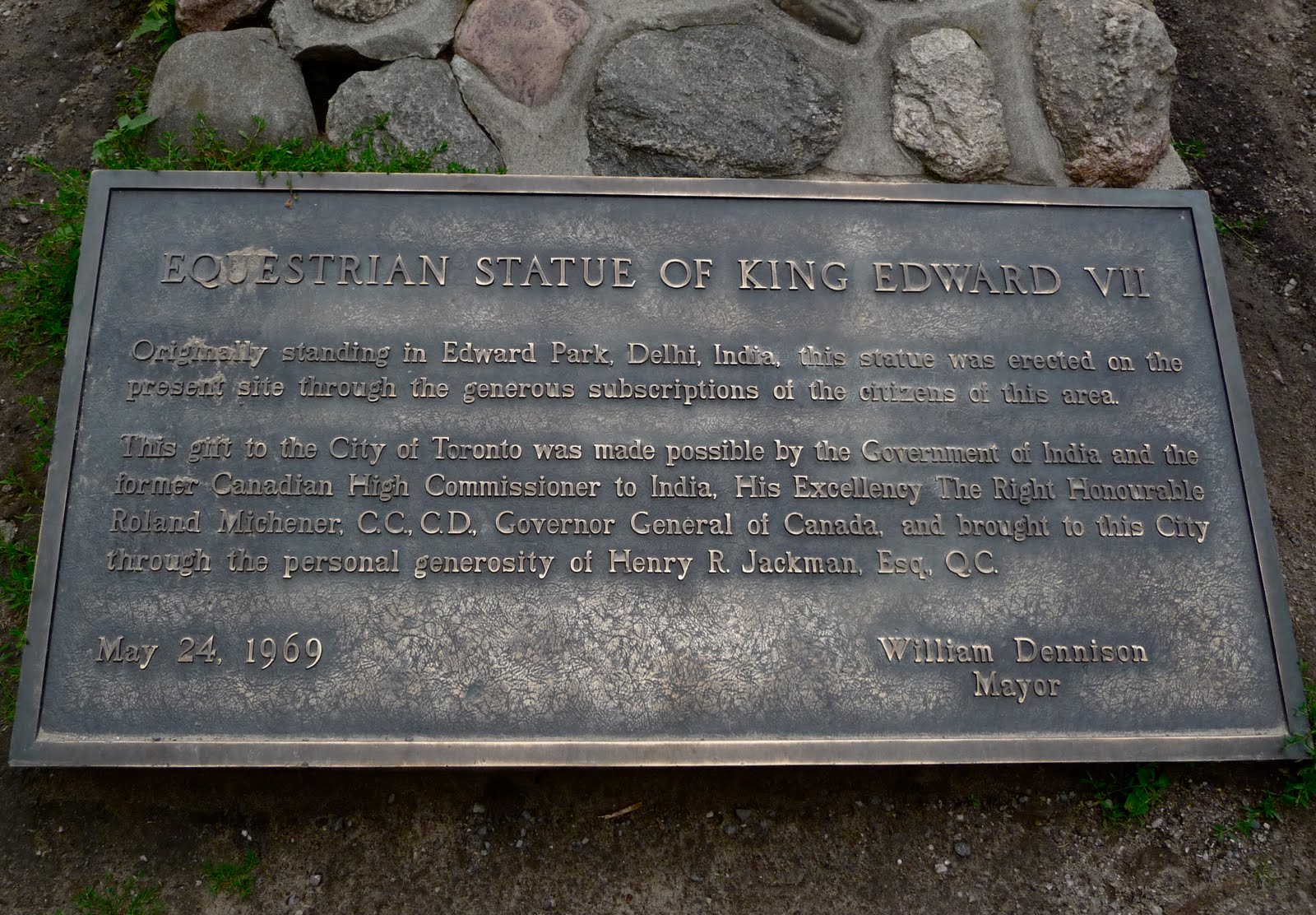
I have been seething about this, and doubtless this explains why I was irritated afresh by the plaque that the City of Toronto placed under the imposing equestrian statue of King Edward VII in Queen's Park. 


It reads: 

"Originally standing in Edward Park, Delhi, India, this statue was erected on the present site through the generous subscriptions of the citizens of this area.


"This gift to the City of Toronto was made possible by the Government of India and the former Canadian High Commissioner to India, His Excellency, The Right Honourable Roland Michener CC, CD, Governor General of Canada, and brought to the City through the personal generosity of Henry R. Jackman CC."  William Dennison, Mayor.

The plaque does not say who made the gift, for it equates the role of the Government of India (GOI) with that of Michener. In fact, the story is that the statue had been relegated to a graveyard for imperial statues in Delhi, and Michener begged it for Toronto from GOI.  Then Henry Jackman paid for the transportation, and local citizens for its erection in Queen's Park.

In her disgustingly arrogant memoir, Michener's daughter tells the story, but expresses no gratitude at all, complaining instead of the delays in transferring the edifice which she attributes to Babu bureaucracy.  She writes as if the thing were her property, tied up by some backward Customs poo-bah.

The plaque gives the impression that the local citizens of Toronto are to be thanked ahead of the actual donors -- the people of India.  The latter are never acknowledged, much less thanked.

A small matter, yes: but indicative of the respect that immigrants and non-English foreigners used to receive in Canada and in Toronto.   

Monday, April 5, 2010

Three Calgary Restaurants

I have been spending some time in Calgary, and took the opportunity to visit three restaurants that people think well of here.

Catch is a restaurant that specializes mostly in fish.  It's located in an older stone building on Centre Street and 8th Avenue, on the well-preserved Stephens Street Mall.  There's an "oyster bar" -- really a pub -- downstairs and an attractive restaurant upstairs.  The restaurant is a very pleasant room and fun to eat in.  

We had the tasting menu.  It started with a risotto cake on caramelized onions.  This dish didn't work.  The cakes were nice and crisp on the outside, but the risotto itself was a disaster -- tasteless and mushy, it had all the culinary pizazz of porridge for babies.  This was followed by an indifferent ravioli with spot prawns -- it's a bit early for spot prawns, I think, and maybe these were frozen last year.  Anyway, they didn't have much flavour -- and when has one ever said that about a freshly caught spot prawn?  The third dish was excellent -- a beautifully prepared broiled "silk" snapper.  The broiler worked perfectly on this one -- though the server told us that most of his customers scrape off the skin.

Overall: B-.

The Osteria de Medici is an expensive restaurant that people like to be seen at -- George W. Bush was taken there, and recently the Edmonton Oilers had a dispute there when they drank themselves silly and then balked at the $20,000 bill.  I was flattered that the Philosophy Department chose this after my talk.  The food, however, was a disasterA limp bruschetta as an amuse bouche, followed by mushy tortellini in a brodo that showed its tomato origins in an slick of pink oil.  Then a spongy grilled chicken breast on undressed vegetables.  Bad cooking, a server who would have been ok at a much less expensive place.  No redeeming virtue.

Overall: F.

The River Cafe is a rustic stone building on Prince's Island.  My daughter and I went there for a lazy lunch on my birthday.  They seated us in a sunbeam by a large window, and we basked for two hours.  I had beautifully prepared pork belly -- slowly cooked so that a rich, almost winey, flavour suffused the whole piece, which was topped by crisp crackling, scored to create a striking pattern.  Accompanied by a small bean and spinach.  Drank a lovely Sicilian Planeta, which complemented the pork perfectly.  Premala ate scallops, for which she expressed great satisfaction.

Overall: A-. 

Thursday, March 18, 2010

Intent/Intention

It's probably after the fact as far as usage is concerned, but may I protest about the use of 'intent' for 'intention'?  As in:  'He chased his dog with the intent of taking it home' instead of '. . . with the intention of taking it home.'

I am pontificating here, and doing so even without proper research (like looking the word up in the Oxford English Dictionary).  But here goes.  'Intent' is an adjective, as in 'She was intent upon ruining our fun'.  It gets turned into an adverb in the usual way, and the adverb reveals the meaning: 'She studied intently'.  'Intent' is a slightly odd adjective in that it requires a complement.  Usually, you cannot be intent without being intent on something.  Hence it can't be used attributively: you can't say 'She is an intent person' because this would be incomplete.  -- Or perhaps you can, meaning that she is to an unusual degree intent on things that she takes up.  But it is surely odd to say 'She is an intent on ruining our fun person'.  

'Intention' is, of course, a noun, and refers to the purpose of an action.

So how did 'intent' come to be used for 'intention'?  One natural, but false, theory is that since 'She was intent on spoiling our fun' means the same as 'She had the intention of spoiling our fun', 'intent' replaced 'intention' in the second.  As I said, this is wrong: the two sentences are not equivalent.   For when you say 'She was intent on . . . ', you don't merely mean that she had the intention, but that she displayed a certain focus and concentration on it.  That's what is revealed by the adverbial transformation to 'intently'.

I think that the confusion came in with the legalism 'with intent'.  I think this is properly used when a course of action has a point of focus, or when everything somebody did was focused on a single point.  'With intent' naturally takes the complement 'to', which says what that focus was.  Thus, 'She drove with intent to break the speed record' suggests that everything she did while driving was directed to this aim.  But then some people slipped into using it where the weaker "with the intention to" or "with the intention of" would have been more appropriate.  Thus, "She drove to Toronto with the intention of saving money" does not properly suggest that all of her driving-related actions were aimed at being money-saving -- she may have driven uneconomically fast -- just that the choice to drive (rather than to fly) were so aimed.

Coming back to 'He chased the dog with the intent to take it home': it suggests that his manner of chasing was particularly well suited to taking the dog home after he caught it.  But surely this is not right.  So maybe there are circumstances in which it would be right to say '. . . with intent to catch it', but not ' . . . with the intent to take it home'.

Monday, March 1, 2010

Two Places I Once Lived In (in Edmonton)

 
The one above (10908 126th St.) has been thoroughly renovated, which is good, since it was such a cold house.  But I was glad to see the colours I chose myself.   It's a beautiful house on a beautiful street.
 
 T

The one above (10317 Villa Ave, I think) is truly a gorgeous old brick place from 1911.  It retains its stately dignity.

Art Gallery of Alberta, Edmonton

So what do we think of the new art gallery in Edmonton?  My own view is that it is a bit too small for its very large ribbons, and doesn't have the grace of Frank Gehry's Chicago Millenium Park bridge.  But it does bring some drama to Winston Churchill Square, which has the City Hall glass pyramid, the Winspear concert hall, and the still charming Citadel Theatre.

 
Here's a shot of the lobby:


One odd feature is the ribbons are made of stainless steel plates, with exposed (but flush) rivets, much like an aircraft wing.  But there are water stains from the rivets (still much like aircraft wings) and places where the plates are not flush to each other (not like a wing).

Harvest Room, Edmonton

Is there a nicer room to eat in than the Harvest Room in the Macdonald Hotel in Edmonton?


This is my friend, Alex, and though the left picture behind him is a little crooked, you must admit that it is an awfully nice place to have lunch.


The food itself used to be better.  The menu for lunch is restricted -- one fish, saltimbocca, a steak, and a vegetarian dish.  Both Alex and I settled on the saltimbocca, which was nice enough -- crisp outside, nice ham inside, and the sage leaf rather tasty.  But whose idea was it serve this on a salad with croutons?

We did have a lovely wine with lunch though -- a Nk'Mip Qwam Qwmt Merlot from the Okanagan, on this last day of the Winter Olympics in Vancouver.  A complex, chocolate heavy, but still fruity wine from the burgeoning wine industry in British Columbia.  The day before we tasted a Sandhill Sangiovese, which was truly sensational.  Go British Columbia!

Wednesday, December 9, 2009

WAM! The Story of an Academic Spat.

I am not an insider in the philosophy of biology. Though I have published on teleology, Aristotle’s theory of teleology, teleosemantics, genetic reductionism, natural selection, and species – a broader range than most insiders – I nevertheless lack the insider’s knowledge of biological science, and so have always been careful to work with other philosophers who know the science better. Perceiving this perhaps, the philosophy of biology community have never treated me as one of them: I don’t get invited to workshops, or to contribute to handbooks, and so on. Nor do I particularly feel at home discussing topics of the sort that regularly receive attention in the journal, Biology and Philosophy, topics that depend on a deep acquaintance with recent literature in biology. My friend and sometime collaborator, Marc Ereshefsky, tends to think of people like me as "cherry-pickers" -- he accuses us of giving undue weight to this or that finding in empirical biology without properly understanding the attendant caveats and cautions.

The philosophy of biology is not, by and large, a sub-area in which pure philosophy goes down very well, or which in turn attracts much attention in pure philosophy circles. For this too there are reasons. A lot of what is published in philosophy of biology venues is reportage of scientific problems, approaches, and even results, accompanied by what is at best a cursory effort to philosophize. And though there are some formidable philosophical minds in this sub-field – Elliott Sober, Philip Kitcher, and Alex Rosenberg, to name a few among the senior figures – most philosophers of biology are not particularly interested in traditional philosophical question. Discussions at philosophy of biology symposia are erudite and abstract, but often not philosophical, not even in the philosophy of science way. There is relatively little contact with traditional philosophy in philosophy of biology discussions of even such questions as teleology or innateness.

I say all this by way of introduction to my recent, mostly enjoyable, but completely unanticipated participation in a big kerfuffle in philosophy of biology. About ten years ago, I was writing something about functions, and since I take an evolutionary view of them, I dashed off a few elementary remarks on natural selection. Roughly, my thought was this: natural selection is the outcome of biases in the births, deaths, and matings of individual organisms. As these events accumulate, certain types increase in frequency while others decrease. There is no cause for these increases and decreases in frequency other than the causes of the individual births, deaths, and matings. So: natural selection is not a cause of evolution – where evolution is constituted by the said changes of frequency. Indeed natural selection is not something over and above the individual events that bring about changes of frequency. Well – I could refine this a bit, but for present purposes, the crude version is enough. That, very crudely, is what I said.

To my surprise, these simple remarks were energetically taken up by one of the editors of the volume for which I was writing – a young philosopher of biology by the name of André Ariew. André had a lot of criticisms of my arguments, but what surprised me was his opinion that my remarks were inflammatory, and that they could not simply be dropped into the middle of an article on functions without a great deal more preparation and argument. This surprised me because I had been under the impression that what I was saying was obvious to anybody who thought about it for more than a minute or two, and that it was certainly not worth wasting anybody’s time with a lengthy exposition. Anyway, I agreed to delete the section in question from the article on functions – and in recognition of the by then quite detailed correspondence between us, I asked André if he would like to collaborate on a new article, which we ultimately called “Two Ways of Thinking About Fitness and Natural Selection.”

In the fall of 2001, we finished this article, and by now having become persuaded that it was not completely vacuous, we sent it off to the Journal of Philosophy. JPhil is a Grand Old Journal in philosophy. Some have criticized it for its refereeing practices – everything is done in-house in the Columbia University philosophy department, and even that august institution has some need for outside advice, the critics say. Nevertheless, it is a philosophy insider’s journal – and for this reason, perhaps, it was a bit bold to send a philosophy of biology article there. Our thought, quite simply, was that one of the best philosophers of biology, Philip Kitcher, a former editor of Philosophy of Science, was on the JPhil board, and that if he liked our piece then it would be published. And if it were published, under Kitcher’s imprimatur, then surely everybody would fall for it.

September 2001 was a bit of an eventful month in New York City, a metropolis that was home not only to Columbia University and JPhil, but also the World Trade Centre. Consequently, our submission was met with a long silence – but once that was over, a stiff-upper-lip apology was issued (“It has been a bit hectic around here . . . “), and within a month, the paper had been accepted. By December, it was being copy-edited, and it appeared in the February 2002 issue. (You can find it here.) I had never experienced this kind of celerity in publishing, and I took it as a good omen. It seemed to me then that everybody would just accept our arguments. They would say “Why didn’t I think of that?” or possibly “That’s what I have always thought”.

Things didn’t turn out quite that way. The reaction in the philosophy of biology community was agitatedly negative. Print reaction takes quite a while, but right off the bat there were replies and criticism in person and on the web. Some of this reaction was to the first half of the paper, which is a critique of Elliott Sober, a very popular figure in philosophy of biology – even we love him (ha, ha!). But a lot of the reaction was to our edict against saying that natural selection is a cause. A lot of biologists want to contrast cases where natural selection is responsible for evolutionary change with cases where other factors such as “random genetic drift” or migration are responsible. And our treatment didn’t allow them to make this contrast in this way -- though we were certainly generous in making suggestions about how this kind of talk could be reformed and accommodated. This upset many philosophers of biology – generally, philosophers of biology are nervous to contradict biologists. (One recent author has said that we were “metaphysically principled”, but untrue to biologists’ linguistic habits. My own opinion, for what it is worth, is that one can’t be metaphysically principled and also follow biologists’ linguistic tics.)

At the time, Denis Walsh was our one friend in all of this. He had in fact scooped our conclusion – though his reasoning was along different lines – and together our interpretation came to be known as the “statistical interpretation of natural selection”. Denis had also worked on a paper with André and Tim Lewens, and initially, the Walsh-Ariew-Lewens-Matthen group were bunched together under the name of WALM. However, Lewens later changed his mind about certain aspects of the statistical interpretation, and I suppose we should now be called WAM. A couple of years later, Denis (who had been at Edinburgh) and I (at the University of British Columbia) both accepted jobs at Toronto – and he and I now tend to call it “The Toronto Interpretation”, though the A in WAM (who is at Columbia, Missouri) is not thrilled by this moniker.

This storm of criticism was really exhilarating for us – at least for me. Critics would make this or that point – usually derisive, and often directed against “WALM”, as if we were Bourbaki – and we would think up a response. (Talking about derisive responses: some critics entitled our view Drift-as-Outcome-Alone, or DOA -- is this clever or what?) Graduate students would write to us and ask what we thought of this or that point their supervisors had made against us in a seminar, and we would defend ourselves. Generally, these exchanges were constructive and fun, and I think that we held our own, and continue to do so. For me in particular, there is very little downside – my day job is in philosophy of perception, and even if I got egg on my face pursuing this avocation, I did not feel that any harm could come to my career. As I said earlier, I am not an insider. The stakes were, of course, a bit higher for Denis and André.

That part of it was fun, but another was not. For though our critics seemed to have no trouble getting into the journals, our responses were rejected. This, of course, is what happens when most of the senior figures in a field agree that you are wrong: the criticisms get published, but your replies do not (and at times it feels that they cannot). But it was frustrating because, as I said just now, I thought we had a bunch of new arguments, as well as some neat responses to criticisms. And never before in my life had I received such contemptuous referee reports – with words such as “ignorant” and “incompetent” occurring in them. For seven years, we were turned away by every journal we submitted to – even good old JPhil said that though they thought that we were right, they also felt that the discussion was becoming a bit "scholastic". (And there was some truth in that.)

Finally, help came from a rather unexpected source. Sympathetic reviews at Philosophy of Science, another grand old journal, though not quite grand or old enough to merit majuscules. André and I had submitted a response to our many critics; I had independently submitted an article on random genetic drift, both significant extensions of the statistical interpretation; Denis had submitted an article on the untenability of causal interpretations. At the time though, Philosophy of Science was somewhat tied up in knots – I am not sure why or how – and it took a long time to get a decision, even though the reviews were sympathetic. Indeed, so long had it been between receiving the “conditional accept” and the final accept, that André and I had more or less decided to move on and submit somewhere else. But suddenly the logjam broke and all of the above articles have appeared or are about to. And though opposition continues, it is generally a bit more respectful than it had been.

I suppose that there’ll be another few rounds. There’s a lot to respond to in our new publications, and as I remarked earlier, print responses take years and years. For now though, I once again enjoy the serene belief that everybody will come to their senses and say either “Oh, I see now what you mean – clearly you are right” or possibly “That’s what I have always thought”.

Sunday, February 1, 2009

What Kind of Stimulus?

Here are some of the things I have heard over the last two weeks:

1. FDR's stimulus spending in the nineteen thirties slowed recovery down. Only when war came in 1939 did the North American and world economies recover from the Great Depression.

2. FDR's stimulus spending was doing a marvellous job, but then his government got panicky and returned to "fiscal discipline". When this happened, the recovery stalled, and only when war came in 1939 did the North American and world economies recover from the Great Depression.

3. Infrastructure spending has a low multiplier effect (less than 1, according to some accounts). Only tax cuts stimulate the economy.

4. Infrastructure spending has a much higher multiplier than tax cuts. Tax cuts only ensure that the government will borrow forever, going deeper and deeper into debt.

5. It is highway robbery for bonuses to be paid to executives when the Government is bailing out their corporations.

6. Bonuses are a normal cost of doing business effectively: not to pay them has the consequence that Government bailout money is handled by incompetent people.

I guess I tend to believe 2, 4, and 5. But I have no better reason to do so than that I want to. I am hoping that Timothy Geithner has better reasons for believing these same propositions.

Thursday, January 29, 2009

Research Funding Worries in Canada

On Tuesday, January 27th, the Harper government brought down its long-awaited budget. The Liberals indicated their support, so the coalition is dead and the Harper government alive.

One of the most worrying features of this government has been its antipathy to intellectuals and artists. As for the latter, Harper traduced artists in the last election campaign as citified types who go to a lot of cocktail parties -- and lost a lot of seats in arts-loving Quebec as a result. As far as this is concerned, the Government may have learned its lesson: 160 million is in the works for big arts festivals (and the attendant cocktail parties in big cities, one imagines). Well, good -- but it's a pity that struggling avant-garde artists won't benefit from this.

With respect to universities, the Harper record hasn't been bad. At least up until now. Paul Martin, the former Prime Minister, was a staunch believer in universities (though not necessarily a supporter of pure research in humanities) and under him, the three federal research granting councils had strong budget increases, peaking (under Harper) at around 2 billion dollars per year. This, together with such programs as the Canada Research Chairs and the Canadian Foundation for Innovation, has brought considerable excitement to Canadian universities
in recent years. There's a palpable feeling of things happening.

In this week's budget, however, the news for research was quite bad. Today (January 29, 2009) the Globe and Mail reported on its front page that Genome Canada's funding from the feds had dropped to zero. This is a high-profile and high-prestige agency, and is very visible in cities like Toronto, Montreal, and Vancouver, which have large medical research establishments. In the 2008 budget, Genome Canada received an increase of 140 million. Today, it's gone from the budget altogether. This seems bizarre. A 100% cut! (UPDATE: Colin Farrely points out that this story is based on a misinterpretation of how the Government funds Genome Canada. It does so by means of one-time grants, not by on-going base funding. In the last two years, Genome Canada got grants of $100m and 140m. These grants can be drawn on any time over the subsequent four years, and are still current. However, no new money came in this year. So things are not as bad as the Globe story suggested, but still quite a bit worse than last year, since GC can't make new commitments.)

At the same time, the budgets of the three granting councils drops by 87 million -- or about 3%. The Social Sciences and Humanities Research Council's budget is cut by 14 million (also in the 3% range). Compounded by a stupid recent emphasis on directed research at SSHRC, and a consequent internal reallocation of funds away from independent research, this could be a very bad development for humanists. (Again, this is a reversal. Last year, the government proposed an 80 million increase in each of two years.)

The news was not all bad though. This is a stimulus budget, and public works are the theme. As part of that theme, colleges and universities are to receive about 2 billion dollars for infrastructure renewal, which must be matched by the provinces. Many Canadian universities suffer (as do universities everywhere) from deferred spending on maintenance, and this should help. There are also some increases to the Canada Graduate Scholarship funds and Canada Foundation for Innovation (which is a source of research infrastructure funding, mainly for scientists).

What's the trend? I don't know, but there is cause for worry. Especially for humanists.

UPDATE: Further evidence now emerges of an anti-intellectual approach to "training". Lisa Shapiro kindly referred me to the Canadian Association of University Teachers analysis of the budget. There it is pointed out that some money has been redirected from granting council base budgets to the Canada Graduate Scholarship program. However, the new money that goes to the Social Sciences and Humanities Research Council for these scholarships will be restricted to students in business related programs!

Another, more positive note: The Government will contribute $50 million to the Institute of Quantum Computing in Waterloo, presumably matching the contribution of Jim Balsillie of Blackberry fame.

Sunday, December 7, 2008

What Michaelle Knew

In my post on Parliamentary Democracy below, I argued that the post of Prime Minister is not well defined in Westminster style democracies. (For example, neither the Constitution of India nor the Canada Act define the office.) There is no clear rule about the length of a Prime Minister's term, or about the conditions under which s/he may hold office. It is also not clear what powers attach to this office. In constitutional fiction, s/he is the first minister of the Queen or the Head of State; by convention, the Queen or Head of State acts on the advice of the Prime Minister. When can the Queen or her viceroy dismiss a Prime Minister? This is far from clear, and constitutional epistemology plays a role.

If the PM enjoys the confidence of the House of Commons, then the Governor-General must do his or her bidding.
On Thursday December 4th, Prime Minister Stephen Harper asked the GG to prorogue Parliament so that he would not have to face the House on a vote of confidence. Should she have acceded to his request? If he had the confidence of the House, she was obliged to do so. If he did not, she was obliged not to do so.

Here's a problem in what I call constitutional epistemology. Does the GG know that Harper did not have the confidence of the House? Well, in the ordinary sense, yes. Nobody could doubt that a majority of members of the House had no confidence in him. They said so. They signed pieces of paper to that effect.

Nevertheless, they had voted to receive the Speech from the Throne. So when the Commons had voted
last in a confidence measure, they demonstrated confidence in Harper's government. Thus, the GG does not know, in a constitutional sense, that he does not have the confidence of the House.

Tortured reasoning? Perhaps, and I'll return to that in a moment. Think of the reasoning that some citizens express on the airwaves and the internet. We know that the electorate rejected Stephane Dion, they say. How can the GG call on him to form a government? This reasoning is irrelevant in two ways. The first and most direct reason for irrelevance is this: as pointed out by many learned people (and by myself in my post on Parliamentary Democracy), we don't get to vote for the Executive. But secondly, just think of constitutional epistemology. If the GG does not know that Stephen Harper has lost the confidence of the House, she surely does not know that the electorate does not want Stephane Dion as PM. We all know it, if we know anything at all. But she does not. Not constitutionally.

OK. On this thread of reasoning, Michaelle Jean was right to prorogue Parliament on the advice of her first minister. Parliament is to open once again on January 26th. On this day, Jean will deliver a speech from the throne. The next day, the Government will present a budget. If the opposition coalition holds, the Government will be defeated on one or both. It will then demonstrably have lost the confidence of the House.

Harper will then advise the GG to dissolve the House and call a fresh election. But as somebody who has lost the confidence of the House, he will not have the right to expect that she will take his advice. He will argue that he has the confidence of the people. But by constitutional epistemology, she will not know this. Perhaps some Canadians will think they know this, and who am I to say they are wrong. The problem is that what they know, or don't know, is irrelevant. The GG cannot know such things.

So here's what I think Michaelle Jean must have said last Thursday: Mr Harper, I will take your advice and prorogue Parliament. But if you lose a confidence vote in the House early next year, don't expect me to dissolve the House. You can't have an election until it is clear that a Government cannot be formed.

If she said all of that, she has my respect. If she only said the first thing, she does not.

Saturday, December 6, 2008

Parliamentary Democracy

Those of us who grew up in the British Commonwealth learned about parliamentary democracy in high school. We are used to the idea that we elect a House of Commons, and that the Government -- the Executive -- is responsible to the Commons. We tend to fall into a certain line of thinking about the nature of voting in this country, and in other former British colonies. When people say: I voted for Stephen Harper, or I didn't vote for Stephane Dion, meaning that they voted Conservative, or didn't vote Liberal, we tend to think that they are just confusing our system with the US system. Here we vote for an MP, right? Unless you live in Calgary Southwest, you couldn't vote for Harper.

Right. But let's ponder for a moment the nature and history of the executive branch of our Government. The Commons itself originally had, in England, no function other than to authorize taxation. An important function, no doubt, but not an executive function. Moreover, ministers didn't sit in the Commons; they were appointed by the sovereign, and held office at the pleasure of the sovereign. In the constitutional fiction under which we live, this is still so.

Some people think that the Commons got its present powers after the so-called Glorious Revolution of 1688. And its legislative powers were certainly enhanced then: for all laws had to go through the Commons. Nevertheless, the Prime Minister (who was not even called that) did not answer to the Commons until much later. Wikipedia correctly says: "throughout the 18th century parliamentarians and legal scholars continued to deny that any such position was known to the Constitution. The title was first referred to on Government documents during the administration of Benjamin Disraeli but did not appear in the formal British Order of Precedence until 1905. George II and George III made strenuous efforts to reclaim the personal power of the Monarch, but the increasing complexity and expense of government meant that a minister who could command the loyalty of the Commons was increasingly necessary."

This means that though there is a substantial body of precedents that define the office of Prime Minister, no law defines the office. Every new decision makes that law. In this country, substantial centralization of powers occurred under recent Prime Ministers. It may well be that in India or Australia, there are subtle differences about how much authority a Prime Minister can claim. And these differences would trace not to legislation, but simply to what former Prime Ministers have done or have been allowed to do.

Moreover, it means that though the electorate votes for Parliament, and thus indirectly for the Government, they still vote under a system according to which Parliament was not the home of Government. In the British system, the Executive is separate from the Legislature -- and that's the assumption that defines voting in Westminster style democracies. We don't really vote for the Executive. In theory, the Prime Minister is still an officer appointed by the Crown, though now more than ever s/he must command the loyalty of the Commons, who votes up the money by which the Crown governs.

Contrast this with France or the United States. There, the electorate votes for both the Executive and the Legislature. We vote for those who authorize or reject legislation, but we do not vote for those who propose and execute legislation. Some think of this as "our system" -- different but just as good.

Last week's events have shown us in Canada that however good our system might be, it is less democratic.